Diseases & conditions
Jaw fractures and traumatic bone loss
Most broken jaws heal once the bone is put back together and held still. When an injury destroys bone or a fracture fails to heal, we rebuild the jaw — and later the missing teeth.
A fresh jaw injury belongs in an emergency department first; this page covers the care that follows.
On this page
Overview
The lower jaw is one of the most commonly fractured facial bones.
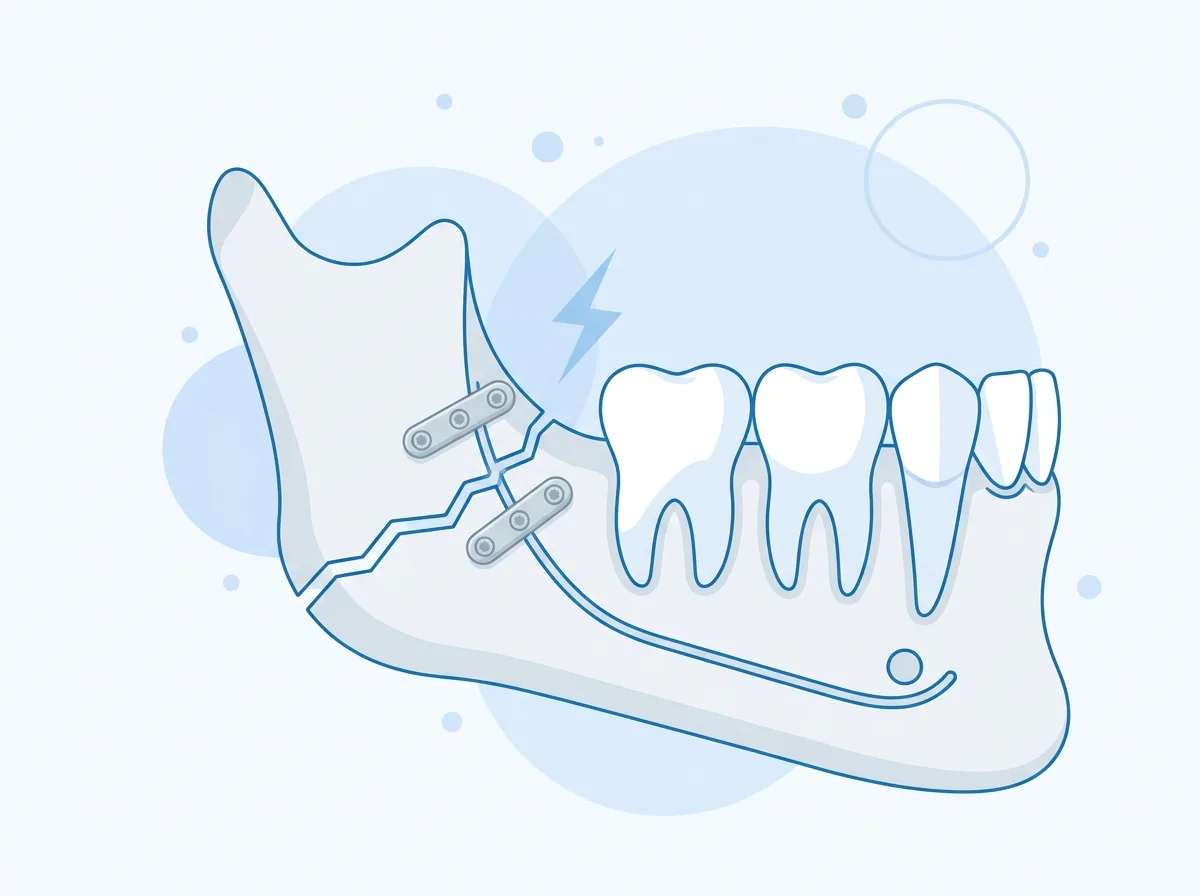
The mandible sits at the front and bottom of the face, so it often takes the force of an impact. Common causes are road traffic accidents, falls, assaults and sports injuries.
High-energy or gunshot injuries can destroy a whole segment of bone, leaving a continuity defect — a gap in the jaw rather than a single break.
Most fractures heal once the bone is put back together and held still. Reconstruction is needed only when bone is missing or a fracture fails to heal.
Fracture sites
Where the jaw breaks shapes the symptoms and the treatment.
The mandible is a U-shaped bone, so a blow often breaks it in two places — for example one break at the chin and another at the opposite joint or angle. The whole jaw is checked, even when only one spot hurts.
Condyle
The rounded head of the jaw joint, just in front of the ear. It often breaks indirectly, from a blow to the chin — such as a fall forwards onto the face.
- Typical signs
- Pain in front of the ear, the jaw drifting to one side on opening, and a changed bite.
- Usual approach
- Often treated conservatively with function therapy; surgery in selected cases.
Angle
The corner of the jaw behind the teeth. An impacted wisdom tooth thins the bone here, which makes it a common site, especially after a blow to the side of the face.
- Typical signs
- Swelling and pain at the angle, a changed bite, limited opening.
- Usual approach
- Displaced fractures are usually plated through the mouth; a wisdom tooth in the fracture line may need removing.
Body
The tooth-bearing part of the jaw between the canine and the angle. The nerve to the lower lip runs inside this bone, so a break here can numb the lip.
- Typical signs
- Torn gum at the break, a step between teeth, numbness of the lip or chin.
- Usual approach
- Closed treatment if barely displaced; open reduction and plating if displaced.
Parasymphysis & symphysis
The symphysis is the midline of the chin and the parasymphysis lies just beside it. Falls onto the chin break the bone here — often together with one or both condyles.
- Typical signs
- A cut under the chin, a step between the lower front teeth, a changed bite.
- Usual approach
- Usually plated through the mouth, with both condyles checked.
Ramus
The upright part of the jaw between the angle and the joint. Thick chewing muscles surround and splint it, so fractures here are less common and often only slightly displaced.
- Typical signs
- Swelling at the back of the cheek, limited opening.
- Usual approach
- Conservative care if the bite is normal; fixation if displaced.
Coronoid
A thin projection of bone under the cheekbone where a chewing muscle attaches. It rarely breaks on its own and usually comes with a cheekbone fracture.
- Typical signs
- Pain or difficulty opening the mouth.
- Usual approach
- Most need no surgery: a soft diet and opening exercises.
Dentoalveolar
Teeth break away together with the small block of bone that holds them, while the main jaw stays whole. Typical after a direct hit to the mouth, such as a sports injury or fall.
- Typical signs
- Several teeth loose or pushed out of line together, bleeding gums.
- Usual approach
- The segment is repositioned and splinted for a few weeks; teeth that cannot be saved can later be replaced with implants.
Diagnosis
A bite and nerve check first, then imaging to see every break.
Bite & nerve check
How the teeth meet (occlusion), how far the mouth opens, and feeling in the lower lip and chin.
Panoramic X-ray
One image of the whole lower jaw and every tooth, which shows a second break.
CT / CBCT with 3D reconstruction
Shows how far fragments have moved, joint fractures and any missing bone, and guides the surgical plan.
Treatment
Three approaches, chosen by how displaced the break is and whether bone is missing.
Every approach has the same aim: a normal bite and bone that heals.
| Approach | How the bone is held | Diet & function | Used when |
|---|---|---|---|
| Closed treatment No incision at the break | Arch bars or IMF screws hold the upper and lower teeth together in the correct bite (intermaxillary fixation) for a few weeks. | Liquid or soft diet while fixed; opening is rebuilt after release. | Stable, minimally displaced fractures where the bite can be restored. |
| Open reduction & internal fixation ORIF | The fragments are lined up and held with titanium miniplates and screws, usually through an incision inside the mouth (intraoral approach). | Usually no long period of wiring, so jaw function returns earlier; soft diet for a while. | Displaced or unstable fractures, several breaks, or a bite that cannot be restored closed. |
| Reconstruction for bone loss Continuity defect or non-union | A reconstruction plate bridges the gap, then vascularized bone — a fibula or iliac crest free flap — replaces the missing segment. Fibula free flapIliac crest flap |
A longer hospital stay and staged recovery; the new bone can later carry implants. | High-energy or gunshot injuries that destroy bone, or fractures that fail to heal. |
A note on condylar fractures
Fractures of the condyle, at the jaw joint, are often treated conservatively: a soft diet and short-term elastics, then function therapy — guided exercises that retrain normal jaw movement. Surgery is reserved for selected cases, such as a badly displaced fracture or a bite that cannot otherwise be restored.
Complex & secondary reconstruction
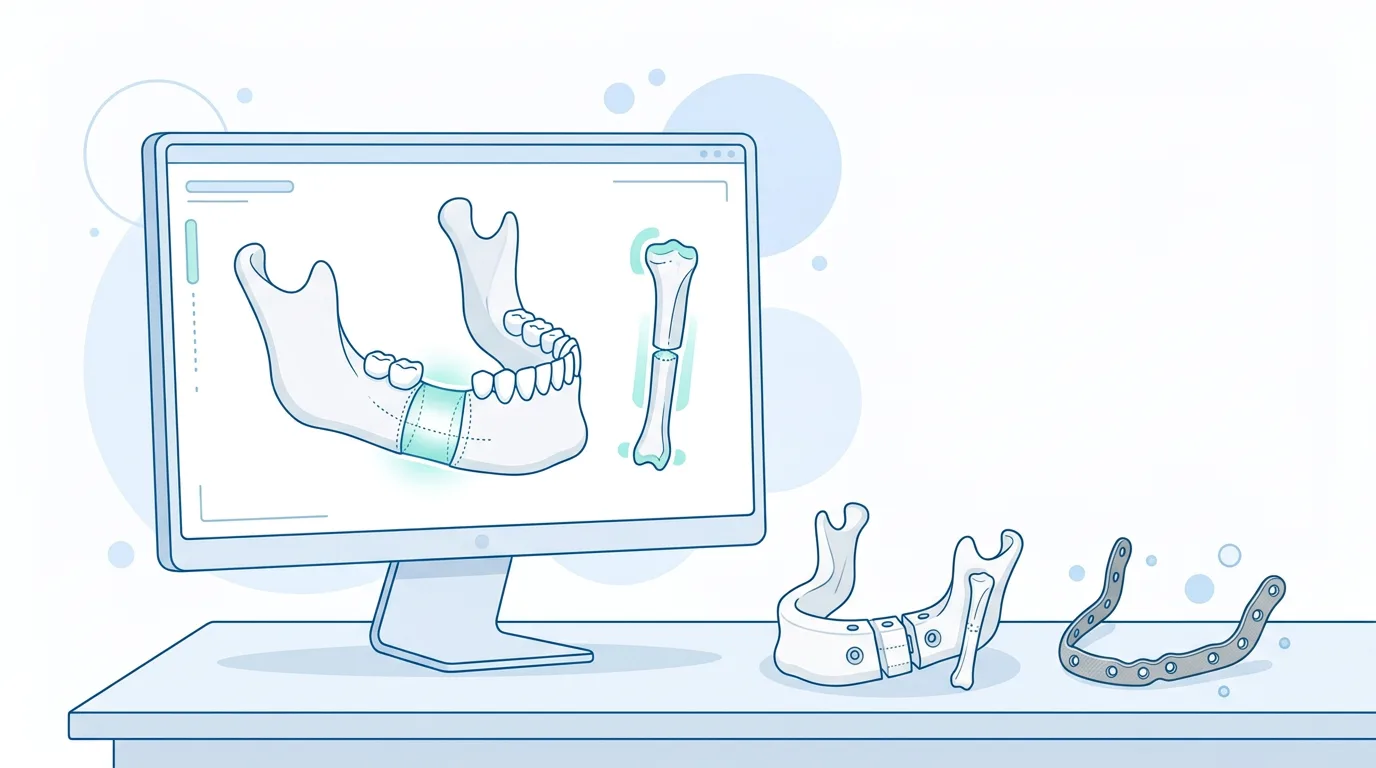
When an injury leaves a large gap, a fracture heals out of line, or earlier treatment has failed, we plan the repair in 3D from your CT scan before surgery.
The plan restores the jaw's pre-injury shape, sets the bone cuts, shapes the flap and plate, and places future implants in advance. Surgical guides carry the plan into the operating room.
Recovery
Bone union typically takes about 6–8 weeks.
During that time, these steps help the bone heal well.
Soft-diet progression
Liquids first, then soft foods, then foods that need chewing — each step when your surgeon says so.
Oral hygiene
Brush gently after every meal and rinse with chlorhexidine to keep wounds and hardware clean.
Medicines as prescribed
Take antibiotics and pain relief as prescribed, and finish the full course of antibiotics.
Jaw exercises
Once fixation is released, guided exercises rebuild how far and how evenly the jaw opens.
Follow-up X-rays
Regular visits and X-rays confirm the bone is staying in place and healing.
Possible complications
Most people recover well, but these problems can occur.
Contact us promptly if swelling increases, or you notice fever, pus or a change in your bite.
Infection
Rising swelling, pain or pus; most settle with antibiotics and drainage.
Malocclusion
The teeth do not meet as before; mild cases improve with adjustment or elastics.
Non-union / malunion
The bone fails to join or joins out of line, and may need further surgery or reconstruction.
Lip or chin numbness
From a bruised or stretched nerve; it often improves over months.
Hardware exposure
A plate shows through the gum and may need treatment or removal once the bone has healed.
TMJ problems
Joint pain, clicking or limited opening, especially after condylar fractures; function therapy helps.
Missing teeth after trauma
Once the bone has healed, implants can replace lost teeth.
Teeth knocked out in the injury, or too damaged to keep, can be replaced with implants once the bone has healed — in your own healed jaw or in a rebuilt fibula or iliac crest.
The same team repairs the jaw and plans the final teeth, so implant positions are considered from the start.
FAQ
Questions patients often ask
Will my jaw be wired shut?
Not always. With closed treatment, the teeth are held together with arch bars or IMF screws for a few weeks. With plates and screws, a long period of wiring is usually not needed and the jaw moves sooner. The choice depends on your fracture.
How long until I can chew normally?
Bone union typically takes about 6–8 weeks. Your diet moves from liquids to soft foods over that time, and back to normal once your surgeon confirms healing.
Will the plates be removed?
Usually not. Titanium plates and screws can stay in place for life. They are removed only if they cause infection, exposure or discomfort, and then after the bone has healed.
Will the numbness go away?
Lip or chin numbness often improves, because the nerve is usually bruised or stretched rather than cut. Recovery can take months, and some people keep a patch of reduced feeling.
Can missing teeth be replaced?
Yes. Once the bone has healed, implants can replace missing teeth, either in your own healed jaw or in rebuilt bone.
Specialist clinics
Mon & Tue afternoons, 2:00–5:00 pm Beijing time
For follow-up after a jaw injury, secondary reconstruction or replacing teeth. Patients, families and referring dentists are welcome to book.